
We are currently witnessing a staggering new escalation of violence in Gaza. With the backdrop of the structural violence caused by a 75-year long Israeli occupation, which has been rife with breaches of international law and been described by many human rights organisations (including Amnesty International, Human Rights Watch and B’tselem) as apartheid, this new escalation has captured the world’s attention. In response to the Hamas attack that killed mainly Israeli civilians on October 7th, Israel has been bombing Gaza and has killed thousands of civilians, mostly women and children. Through the accessibility of social media, we are able to witness in real time the cost of war. Reports of medicine, food, fuel and water blockades and images of civilian spaces such as hospitals and refugee camps being bombed in Gaza are documenting deep violations of international humanitarian law and, on a human level, are devastating to witness. We join the calls of many around the world for a ceasefire and a peaceful resolution of this conflict, one that upholds the values of dignity for the Palestinian people as well as the Israelis. In the spirit of a human security analysis, this peaceful resolution cannot merely include an end to this cycle of violence but must constitute an end to the unbearable structural violence many Palestinians have been facing for years.
Since 9/11 2001, the world has been dominated by hard security discourses, frameworks, regulations and interventions seemingly trumping all other paths to peace and stability. This wave of securitization has not stopped violence, but on the contrary has led to a perpetuation and even an increase of violence, to the derogation of rights and due process, and ultimately, to less safety everywhere. Our work has taught us that, aside from the legal and moral obligations to adhere to human rights principles, states must stop the continuation of these vicious cycles of violence by considering the long-term negative consequences that state violence has on societies and their security. When security approaches are unable to respond adequately to human rights violations, violations of international law and humanitarian law, we see legitimate grievances and pain turn into acts of revengeful violence. The path to sustainable peace can only be brought about by addressing the root causes of violence, where we find injustice, marginalization and social exclusion at the center. We need peaceful means and mechanisms of conflict resolution that provide human security and justice for all.
A cornerstone of our work at Human Security Collective has been to highlight the harms caused by security approaches including counterterrorism that make human rights optional and do not take into account the security needs of communities they target.
In the past two years, Human Security Collective has implemented the Civic Horizons project together with partners in six countries in the MENA region. The project is funded by the EU and aims to work on the operational environment of civil society in order to defend human rights, democracy and fundamental freedoms. As HSC, part of our work under this project has focused on understanding the drivers of distrust between communities and human rights organisations and addressing these. In each of the seven communities in which we have been active, we have built relations with changemakers: members of civil society organisations, movements, activists, etc. These relations are based on listening, empathy and trust. In the past weeks, since Israel’s response to the attack by Hamas, we have seen their pain, anger and sadness grow as well as that of their communities. As they seek to tell their truth and stories they are met with shadowbans and censorship. They feel that in traditional Western media and on social media there is a bias against those advocating for Palestinian rights. But their anger also stems from their disappointment in the international community, the US and EU’s political leaders, as well as international and national civil society organisations. From where they stand, the champions of human rights seem rather hypocritical, caring unequally for civilian lives and enabling the unfolding violence. For those who care to listen to the people in the MENA, and especially the young people in the region, you will realise to what extent the trust is shattered.
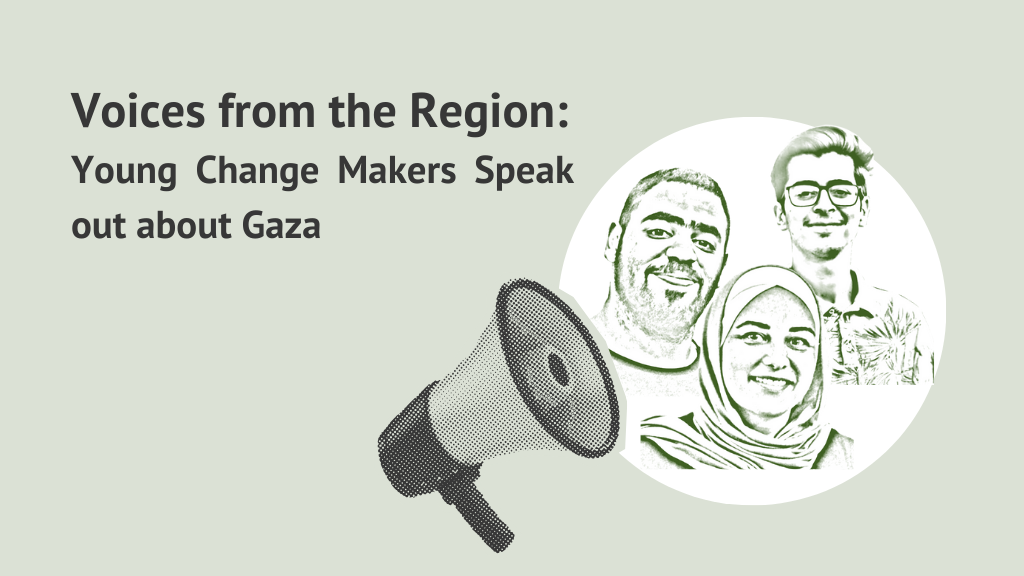
In the face of the censorship these changemakers are met with, we at HSC have decided to share our platform with some of them so that their voices can reach people outside their direct circles. We have asked them to share their stories and tell us more specifically how the Israel–Gaza war is impacting their sense of security and that of the people in their community. Asking people about their sense of security is a simple and relatable question that we often ask participants in our projects. It always brings about personal, diverse and insightful answers about what makes people feel safe and unsafe. The question and the discussions that emanate from it recentre the focus on people’s right to be free from fear and want, in other words on their right to human security.
The stories you will read next are those of young changemakers living in Lebanon, Jordan and Tunisia. Their stories are personal accounts that seek to recentre our focus on human security.