
How can education prepare young people not only for a career, but also for active participation in society?
In this interview, Phyllis Livaha, senior lecturer at Erasmus University College (EUC) reflects on the value of linking education and practice, what students gain from engaging directly with communities, and why human rights education is most impactful when it moves beyond the classroom.
Through the Move 4 Human Rights (M4HR) program, young people engage with human rights issues beyond formal learning environments by working directly with communities and civil society organizations to investigate local human rights challenges and develop practical responses. In this context, Human Security Collective contributes by bridging educational frameworks and practice, helping connect classroom learning with lived experience and civic engagement.
_____________________________________________________________________________________________________________________________

Why do you think partnerships between educational institutions and organizations working on human rights are important for students?
It’s valuable because it connects academic learning with real-world practice. Students do not only read theories or discuss concepts in the classroom, but they also see how human rights work is carried out on the ground, with real communities and real challenges.
That makes learning more meaningful because it shows that knowledge is not just abstract — it has practical, ethical, and social dimensions. It also helps students understand the difference between studying an issue and actually engaging with the people and organizations working to address it.
In that sense, students move from being passive consumers of information to becoming active agents of change.
What does this kind of learning approach add to traditional education?
It adds an experiential and social dimension that traditional education sometimes lacks.
Classroom learning is important for building foundations, but when we work with students through these kinds of projects, it helps them connect ideas to lived realities, civic responsibility, and social impact.
This also encourages them to think about how knowledge can be used not just to explain the world, but also to improve it. In that sense, it makes education more active, more grounded, and more relevant to the societies that students are actually part of.
“This also encourages them to think about how knowledge can be used not just to explain the world, but also to improve it”
What do students gain when they engage directly with the communities affected by human rights breaches?
I think the greatest asset students gain is proximity to humanity.
Books and articles are essential, but they often filter real human stories through academic language. When students engage directly with survivors, grassroots organizers, and community leaders, they learn the invaluable skill of active listening.
They learn that human rights is not just about legal status, but also about dignity, trust, and relationships.
That direct engagement fosters a deep sense of humility and ethical responsibility. They are not just studying a subject anymore — they are honoring stories and collaborating with communities. That shifts their entire perspective on what it means to be a professional and a citizen.
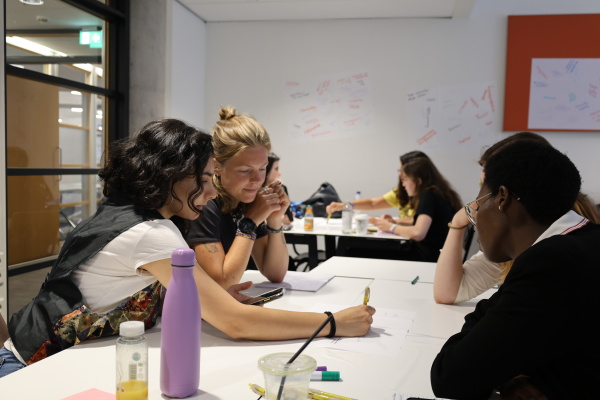
What is one thing you take away from working with students through the Move 4 Human Rights program?
It’s easy to fall into the trap of thinking that knowledge only goes one way — from the expert or organization to the student.
But in reality, students bring an incredible amount of fresh energy, critical curiosity, and innovative thinking. They challenge assumptions, ask sharp questions, and force us to rethink our approaches.
Their passion and commitment are really revitalizing. They remind us that the next generation of advocates is already highly capable of leading the conversation.
 .
. 
Looking beyond this program, what do you think this approach contributes to education more broadly?
It helps build lifelong learners. Learning is not something that ends with a degree — it’s an ongoing process shaped by curiosity, reflection, and engagement with the world and the people around us. Every day offers a chance to learn from others, from experience, and from changing social realities.
It also helps break the separation between academia and the real world. By linking real-world crises with academic theory, you create a feedback loop where theory informs practice and reality refines theory. This produces graduates who are not only theoretically strong, but also ready to engage with complex, real-world challenges.
______________________________________________________________________________________________________________
At Human Security Collective, we believe that meaningful learning takes place when education is connected to lived experience. Through the Move 4 Human Rights program and partnerships with institutions such as Erasmus University College, we work to create opportunities for young people to engage with human rights issues in practice, develop critical skills, and contribute to positive social change.
About Move 4 Human Rights
Move 4 Human Rights (M4HR) is an MDT (Maatschappelijke Diensttijd) program that brings together human rights organizations and educational institutions in the Netherlands. MDT is a voluntary social service initiative of the Dutch Ministry of Education, Culture, and Science that encourages young people to develop their talents while contributing to society.
Through M4HR, young people bridge theory and practice by engaging with issues related to human rights, social justice, and inclusion.